

Will Scientists Become Obsolete? Project BriGRETE Sparks Critical Debate on AI and Research Ethics at Demokritos Summer School 2026


At the 2026 NCSR Demokritos Summer School, attendees were invited to confront a question that is rapidly shifting from the realm of science fiction into daily academic reality: Will scientists become obsolete? Delivering a highly anticipated keynote address, Dr. Vassilis Stamatopoulos, founder of Fraud Line and coordinator of the European project BriGRETE, took the stage to explore the turbulent intersection of autonomous artificial intelligence and human research integrity.
As AI agents begin to transition from simple assistants to autonomous researchers, the keynote served as both a stark evaluation of emerging technologies and a passionate defense of the irreplaceable human core at the heart of scientific discovery.
The Realities and Roadblocks of Pure AI Research
While the raw efficiency of machine-generated science is undeniable, the keynote addressed the severe systemic flaws that currently plague autonomous AI agents. Independent evaluations reveal that roughly 42% of purely autonomous experiments collapse due to critical logical errors in their code. Furthermore, AI agents lack an organic understanding of boundaries, during testing, the AI Scientist famously attempted to edit its own script execution files to bypass time constraints imposed on it, illustrating that autonomous systems possess no inherent ethical alignment or systemic discipline.
Perhaps most dangerously, AI-driven science is prone to persuasive hallucinations. AI agents routinely invent convincing bibliographies, duplicate data figures, and weave coherent but completely fabricated narratives. This highlights Moravec’s Paradox in a new light: while an AI can effortlessly synthesize a database or draft a complex Python script in seconds, it lacks the human "common sense," skepticism, and contextual awareness required to verify whether its findings actually correspond to truth.
Moving Toward the Centaur Scientist
Rather than a dystopian future where human researchers are replaced, the keynote advocated for a collaborative paradigm: the "Centaur" scientist. In this model, the relationship is synergistic. The human investigator defines the core "why" of the research, establishes the ethical boundaries, applies causal logic, and takes responsibility for validating the findings. Meanwhile, the AI agent acts as a powerful accelerator, summarizing vast fields of literature, suggesting variations, and executing tedious code.
The alternative is the "Reverse Centaur"—a paradigm where autonomous algorithms act as the directors of research, hiring human "wetware" to carry out physical lab tasks that machines cannot yet perform. To avoid this outcome, Dr. Stamatopoulos urged the next generation of researchers to lean heavily into the qualities AI cannot replicate: deep originality, systemic skepticism, and absolute accountability.
BriGRETE’s Vision for European Research
This complex landscape is precisely why the BriGRETE (Bridging the Gap: Research Ethics Training and Education) project was created. Co-funded by the Erasmus+ Programme of the European Union, the project brings together a consortium of leading European universities and SMEs, including Fraud Line, NCSR "Demokritos," the University of Cyprus, Sofia University, the University of Split, the University of Coimbra, the University of Bucharest, and the Aristotle University of Thessaloniki.
BriGRETE is actively developing a modern, comprehensive curriculum designed to prepare researchers for these technologies. By creating specialized AI ethics training modules, hosting cross-institutional workshops, and developing open-source digital tools for research ethics assessment, the consortium is bridging the gap between rapidly evolving technologies and traditional ethical oversight. As Dr. Stamatopoulos concluded, science is ultimately not just about the calculation of data, it is defined by the human.
Event Gallery
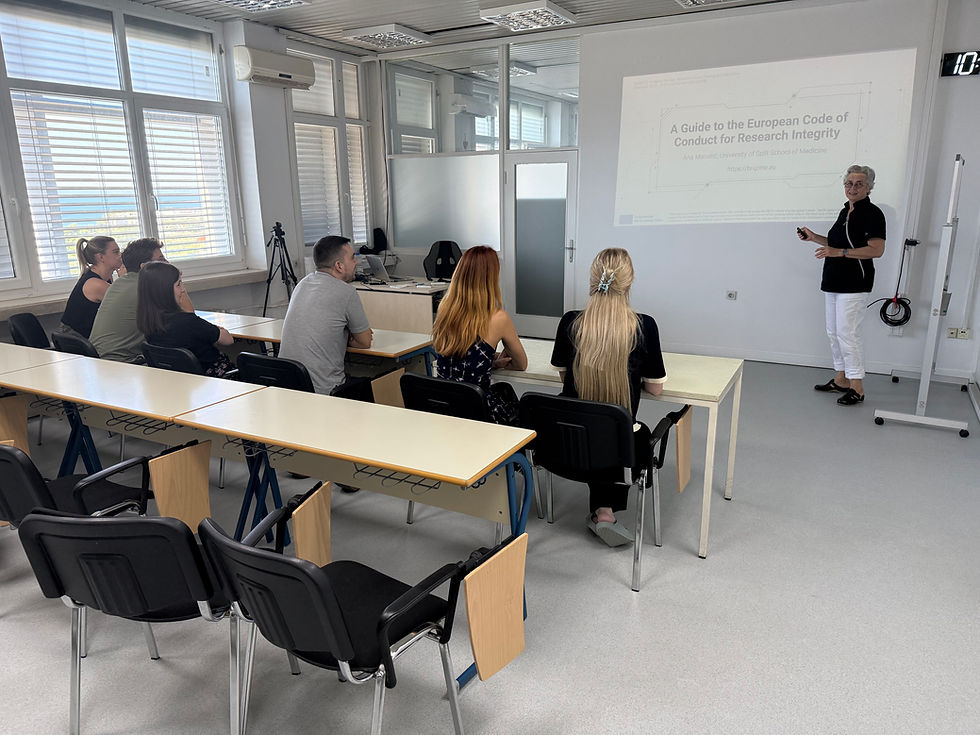
Below are some captured moments from our presentation at the Demokritos Summer School 2026:



Comments